FAQs

HomeFAQs

FAQs: how I answer visitor questions at my exhibitions.

Citing texts by Brigitte Badina, the Cité Internationale de la Tapisserie in Aubusson, Chantal Danjou, Delphine Flamme, Thomas Leveugle, Oxford English Dictionary, Published by Oxford University Press, 1989.

Inspiration

Myriad roots ?

Following the groove of fundamental influences:
The mosaics at the Alhambra in Grenada, Hokusai,
The Bauhaus artists: Paul Klee, Johannes Itten, Wassily Kandinsky, Josef Albers, and de Stiel:
Piet Mondrian and Theo Van Doesburg
Op Art
and Victor Vasarely
And the timeless techniques used in popular crafts: ancient quilts, molas by the Guna: my textile scores draw on these basic compositions.
My own patterns gradually took shape in my imagination, finding freedom in self- expression

How did you get into Bauhaus?

I collect art drawings; I drew inspiration from a body of work that I had gradually put together. Years later I realised that most of the drawings I had gathered were by artists from one and the same school, Bauhaus, founded in Weimar in 1919 by architect Walter Gropius.

What does Bauhaus bring to your creative process?

Throughout the design stage, Bauhaus painters’ research shapes my own in five dimensions:

  • Colour and its intrinsic vibrations
  • Repetition and geometric structure, seeking a new pace with a series of shapes that are similar, or invite interaction
  • Texture, because textiles encompass a wide range of different materials, with an infinity of variations, much like wood.
  • Light, with the interplay of effects produced by colour and texture, as in stained glass.
  • Simplification to achieve strength, a sense of mystery and timeless appeal, in an approach rather like that of a designer.

Beyond Bauhaus ?

Further to discovering these fundamental artists, I have been influenced by other great artists:

  • Vieira da Silva’s work with perspective, which I sketched at the Musée des Beaux-arts in Lyon before finding out who she was; 
  • Fabienne Verdier who I discovered at the Alice Pauli gallery in Lausanne (Switzerland), and her output resulting from protracted meditation;
  • Abdoulaye Konate at the Biennale textile FITE then the Manifestra gallery in Lyon (France), for his use of bazins with a colour range tapping into tapestry;
  • El Anatsui in Avignon at the exhibition Les Eclaireurs then at the Haus der Kunst in Munich (Germany) for his draping and pared-down colour range;
  • Robert Wogensky at the bookshop of the Cité Internationale de la Tapisserie in Aubusson (France) for the sheer force of his drawings and his minimalist colour schemes;
  • Koichi Kiruta for his daily collection of soil samples and corresponding meditative approach. 

Traditional arts from the Far East?

Regularly practising Tai chi chuan and yoga affords insights into percepts of energy, breath and impermanence. These practices nourish my artistic approach and breathe a unique vibration into my works.

Composition

What role has geometry played in your approach?

Geometry helped to shape my initial experimentations with colour. Using my first textile collections, I explored the most sophisticated of patterns.

I gradually built up my textile collections, taking my time, opening up to a wide variety of fabrics. I streamlined the basic shapes. Using squares as a base leaves more room for an extended colour range, granting greater prominence for the material.

Why use odd symmetry?

I apply the principles of universal harmony, using odd symmetry, prime numbers, the golden ratio and geometric sequences. 

These mathematical rules which govern nature, the cosmos, antique and medieval architecture, help to build a harmonious work in interaction with its environment. 

The onlooker feels the pull of the work, prompting much pondering: they seek out inexistant symmetry, thus deepening their spirit’s understanding of form.

Modelo et Replica ?

Working as an architect nurtured my fascination for changes in scale. They wreak considerable changes in depth and how the work is perceived. A unique dynamic emerges between two works sparked by the same inspiration but on different scales. Renaissance painters produced modelos as guidelines for their studio assistants.

Inversely, El Greco produced replicas as a means of distribution, which were easier to sell to private collectors, and as business cards to promote his style in non-religious circles

Why use such tiny squares?

All artists keep their samples, remnants and scraps. But rather than letting them lie dormant in a drawer, they spark the imagination anew., Seeing the short strips of fabric left over from the building of my log cabin (very thin concentric strips the drawings of which recall log cabins), Amish stars and colour prints of finished works, I felt the urge to assemble and weave them into a heritage work.

What is your largest work to date?

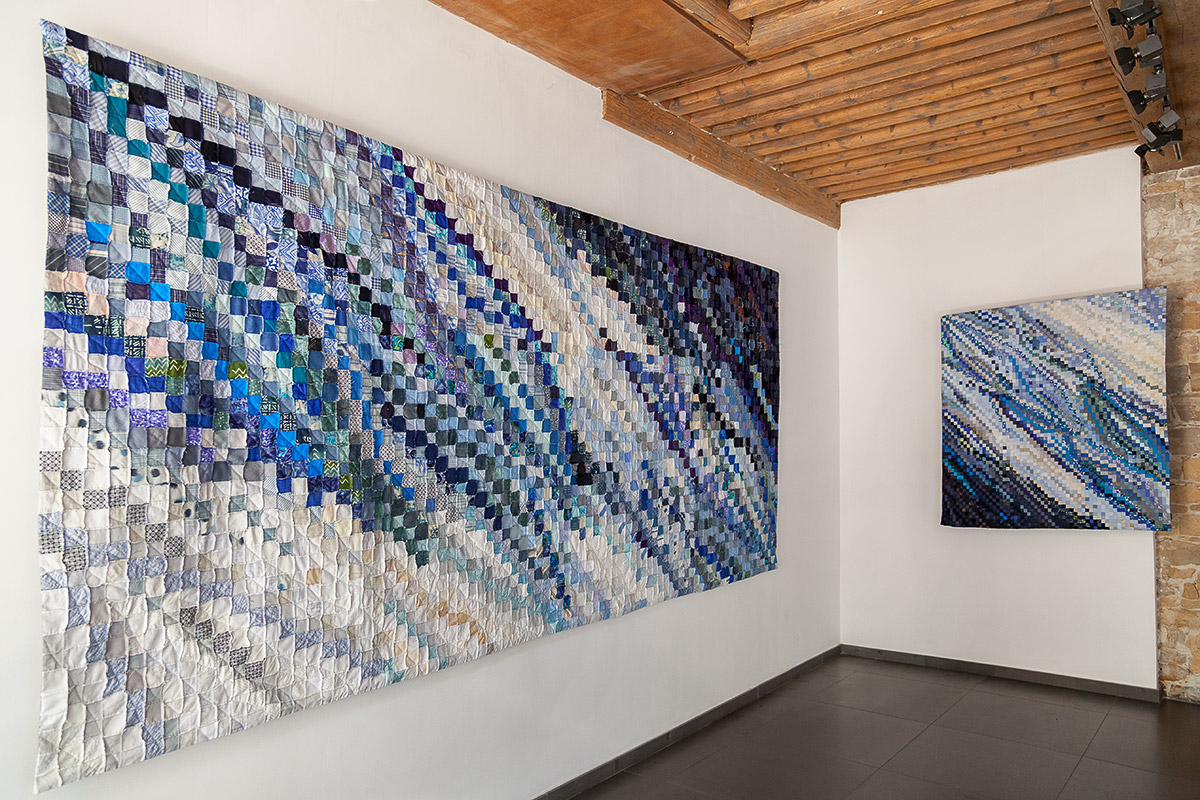
Sabine Cibert - Art Textile Contemporain - Perspective Eau Vive 2 - et vue partielle de Eau Vive 1

Eau vive 2 – Running Water 2

210 x 441 cm, 9.3 sq.m
4400 g

WIP Magma 5

308 x 485 cm 14.9 sq.m

What is your smallest work?

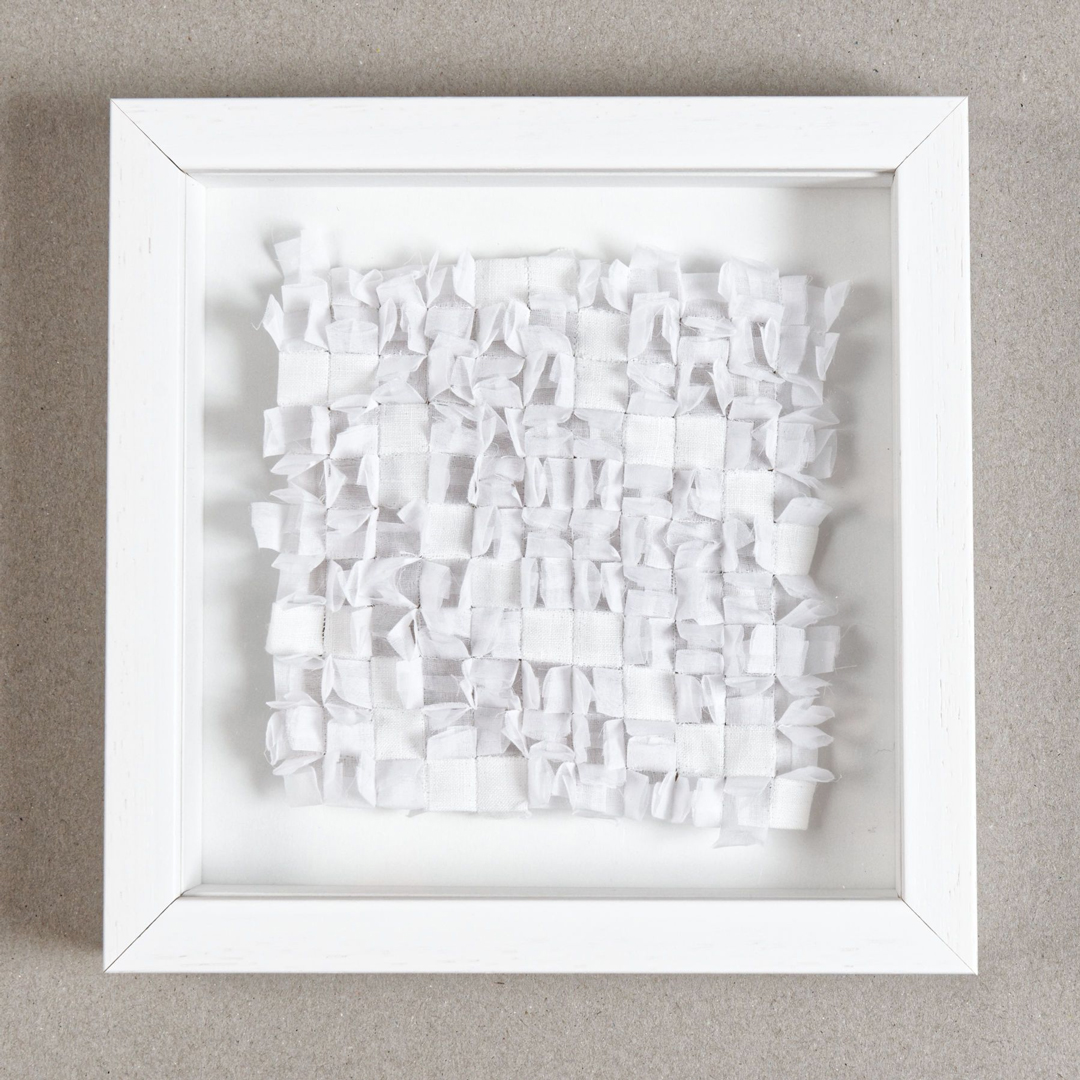
Sabine Cibert - Art Textile Contemporain - FAQ - série Dégel et oeuvre neige 263Neige 263Snow 263

15 x 15 cm, 0.02 sq.m

8 g 

Installation

How to hang the textile works?

Top and bottom sheathes sewn at the back tauten the work using aluminium tubes assembled on an elastic band. The sheaths are broken up in order to slip separate nylon threads through them.

The work hangs on these nylon threads, around 10 cm away from the wall. Alternatively, S-shaped hooks hanging from a rail can also be used to hang them against the wall.

How to preserve the textile works?

Store textile works away from direct sunlight. 

Once or twice a year, remove dust by vacuuming them on low, either from the back or through a piece of cotton muslin.

Fabrics

What are your favourite textiles?

For decades, my textile collection has featured various key fabrics: bazin, chambray, pick and pick, ottoman, ikat and crepe…

Where does your immense range of textiles come from?

Offcuts from textile mills, samples, end of bolt remnants, fabrics sold by the metre from a time when shops offered a very broad range of fabrics, have all contributed to my textile collections.

Sometimes people call me to organise inherited textiles.

These organised textile collections give me immense freedom to explore colour.

There is also a great variety of what the French call noble fabrics, which are in fact natural: cotton, linen, silk and wool.

This never-ending quest for textiles calls for careful filing. I now have a file detailing 150 boxes of fabric, in a broad spectrum of colours. 

Lines of force combined with a textile collection leads to textile compositions that often come in series.

Weaving and weaves?

According to the Oxford English Dictionary, weaving is the act of “form(ing) fabric by interlacing long threads … with others at a right angle” and a weave is “a particular style or manner in which something is woven”.

Do you dye any of your textiles?

I use my textiles as they come, without dyeing or embroidering over them. I am mainly interested in seeking out harmony using a pre-determined colour range, even if that means waiting to find the missing textile. Since my Dawn series, I have used layers of sheer textiles to enjoy yet more chromatic transitions.

Why do you sew by hand?

A supple hand is an intrinsic feature of the surface effect I seek. Machine sewing rigidifies the fabric.

Assembling a wide variety of fabrics and weaves is only achievable with the dot-dot-dot of hand sewing.

Hand sewing frees up the corners.

And lastly, silence and freedom of posture enjoyed when hand sewing are crucial to my creative process. 

Techniques

Which traditional techniques do you use?

Quilts

Taking a host of tiny elements to produce a large, warm expanse of fabric to be used as a screen, windbreaker or blanket, has been a staple source of comfort in subsistence economies among nomadic and sedentary societies across all five continents. 

The term quilt is derived from Old French “coilte” which is also the origin of the French word for duvet “couette”. It commonly refers to a large blanket made up of pieces of fabrics assembled then sewn to a cotton or polyester core in order to trap heat and strengthen the initial seams. Composition is based on the repetition of similar parts, either identical or symmetric- known as “blocks”. An extra block is often made for extra ease when putting everything together at the end. Having one extra means you can remove the one that fits in least with the overall pattern. 

The most visually spectacular compositions were produced in the 19th century, in particular in the Netherlands, as well as Amish quilts made using plain fabrics. 

Molas, Pa n’Dau

The Native Americans living in the San Blas Islands to the north of Nicaragua used to adorn their bodies with paint. When missionaries arrived, they forced them to wear clothing; so they transposed the motifs on their bodies to bustiers made using several layers of fabrics, slitted and then folded and sewn. The brightly coloured backs and bodices feature interacting symbols, referring both to duality and a full account of the origins of the cosmos. Mola means “fabric” in the Guna language. This technique involving the layering and slitting of fabric has been magnified on symmetrical and concentric shapes by the Hmong tribe in south-west China, who call it Pa Ndau. 

In Egypt, men also make layered textiles using the same technique. 

I copied many molas in order to learn about the technique and how their colours interact. I then reprised the technique in black and white for my Réminiscences series. Molas are achieved by slashing a top layer of fabric which is then stitched back to reveal another layer underneath. The ensuing thick and thin lines interact with those of other blocks. The weave and folds in the fabric inform the direction of the incision. 

Nowadays I use this technique for my signature.

From the first assembly to a unique medium?

I start by assembling the pieces of textile to gradually create an initial surface.
This is layered over a silk core and canvas backing. These three layers are then sewn together to stretch the fabric taut using a set of discreet dotted stitches.

During this last step, the material becomes a cohesive whole, producing a medium with unique mechanical, acoustic and thermal properties. The canvas conjures up an especially sensitive dual impression of intimacy and grandeur.

What are the advantages of quilting techniques for large formats?

The three layers, achieved in several different steps, makes it possible to adjust the tension applied to the textiles, ensuring both its supple hand and drape. This considerably reduces the likelihood of deformation. So large formats can be hung vertically without slumping.

What is paper piecing?

The French call it the “English folding method”. Paper piecing is a technique whereby shapes of fabric are folded over paper or cardboard. It is useful with fragile fabrics such as silk and complex shapes such as hexagons, ensuring surfaces with clean joining lines and corners. I first explored this while copying ancient works. 

I recently adapted the card/fabric ratio to around ⅓: the ensuing layering of folds allows for a greater variety of surface and volume effects, reminiscent of origami.

What technical innovations have you used during your textile art journey?

Showing the underside 

While making the first of the Running Water series I realised that the underside afforded a wealth of different shapes. And it was due to disappear as I assembled the three layers of the work. On the top side, the right side, the squares sit neatly side by side, each in their rightful place, while underneath they merge together, their boundaries are blurred. 

This is what gave me the idea of a “back-to-front” work, to provide a fresh view. The stitching is visible, you can see how it was made, achieving greater optical impact. 

The actual thickness brings a third dimension to the composition, and the ambiguous boundaries produce a blurry effect.

Series such as Running Water, Thaw, Magma and The Skin of the World fluctuate between 2-dimensional compositions which are flat and smooth, and others showcasing of relief by way of varying thicknesses.

Using ever more varied materials

I have gradually added to the cotton I originally used, with fabrics requiring greater dexterity such as wool, silk, damask polyester and Lurex. To ensure that the squares are all equally thick, I line them, sometimes with a double lining or fusible interfacing. With tiny amounts of rare fabrics to make the textile score utterly unique.

Layering sheer fabrics 

For the Dawn series, I sought out sheer textiles in various colours as a way of broadening my colour palette. Layering various colours together produced original nuances and new materials.

Small formats like origami 

The small, framed formats are a departure from the traditional technique I previously used. After the Snow series, the Storm series was an opportunity to use a reduced 15 x 15 cm format and rework the drawing style appropriate for large formats. 

Another new feature of this graphic tour de force was the production of various objects spurring me to explore the interactions between small volumes. Infinite vibrations were produced with paper piecing, with the card sometimes left in. 

An invasion of colour?

As I added to my textile collections, I broke free from the lines of force and let colour take over.

In 2018, I posited the Dawn series as a research project. This series explores the imperceptible shifts in colour at sunrise. Patiently collecting a host of nuances, materials and weaves to depict the origin of light shining the night away.

Going digital

How do you use drawing software during your creative process?

I gradually achieved a better balance between the time I spent on design and on actual production. And I leveraged software t develop the design phases: imagining and composing several variants and choices of colours.

These explorations revealed the full importance of the tool used to shape my musings and artistic explorations.

What software do you use?

I started out on the classic Quilt Pro, for traditional quilting, but needed something that would better handle colour and texture. Illustrator helped me make headway with this, and especially improved my command of the basics of geometry for an Alhambra mosaic. I also dipped into Ragtime, which was easy to use and could handle my many photos. Then I chose Photoshop / The Gimp which helped me hone my use of the material and fabric textures to obtain a result as close as possible to reality. 

I then circled back to a vectorial application, Inkscape, to handle tracing, easy dimensioning and item counting.

And a simple layout tool helped me study compositions using studio photos.

I feel that changing software is important to freshen up my thought processes.

How important are photos in your creative process?

The “Inspiration” photo

I take very few photos; I prefer to absorb moods without reducing them to a visual aspect. However, with particularly strong visual emotions, I do decide to make a record. 

Later, a set of photos depicting different times and places may inspire a composition, once I have thought its scale through.

“Studio tales” photos

I use photos in my studio to keep records of the design and to prepare for the next steps, the quilting design for example.
My Semagrams were designed based on specific details in photos from the Moments series. The lines of force for the composition were based on these details.

I may also use photos of blocks at pinning or sewing stage to explore all sorts of compositions and choose the one with the greatest impact. 

“Archetype” photos

Lastly, when the schedule is not too tight, I ask a professional to take photos of the pinned blocks. 

My studio tales also feature the moment when I choose the colour scheme for all the pinned textile squares. The photograph puts forward a new surface combining the weave and the direction of the pins. They help me imagine the transformation from 2D composition to object, joining everything up to produce a 3D work. 

This raw material may be printed on tracing paper and exhibited floating to recreate the archetype of a work.

Bibliography

What reference books do you use?

(Works in French unless an English title is given)

Le mural nomade Tapisseries modernes et contemporaines au couvent de la Tourette
Publisher: Bernard Chauveau Éditeur 2020
ISBN 978-2-36306-287-1

Vieira da Silva, the Eye of the Labyrinth
Publisher In Fine 2022
Exhibition 10 June 2022 to 6 November 2022 Musée Cantini Marseille
and 16 December 2022 to 6 November 2023 Musée des Beaux-arts de Dijon
ISBN 978-2-38203-063-9

The Golden Ratio
Mario Livio
Publisher: ‎ Headline Review
Publication date: ‎ 4 Aug. 2003
ISBN-10: ‎ 0747249881
ISBN-13: ‎ 978-0747249887

Golden Section: Nature’s Greatest Secret
Scott Olsen
Publisher: ‎ Wooden Books
Publication date: ‎ 22 Sept. 2009
ISBN-10: ‎ 190426347X
ISBN-13: ‎ 978-1904263470

The Art of Folding: New Trends, Techniques and Materials: Design without Boundaries
Jean-Charles Trebbi, Chloé Genevaux, Guillaume Bounoure
Publisher: Promopress
ISBN-10: ‎ 8417412328
ISBN-13: ‎ 978-8417412326

Paul Klee, le Théâtre de la Vie
Palais des Beaux-arts, Brussels
1 March 2008 – 11 May 2008
ISBN 978 906153 812 7

Roger Druet, l’allégresse de l’écriture
Ateliers Perrousseaux et Amis du Musée de l’Imprimerie 2008
ISBN 978-2-911220-27-2

Antique Ohio Amish Quilts, The Darwin D. Bearley collection
Jonathan Hostein
Publisher: Bernina 2006

Facts & Fabrications – Unraveling the History of Quilts & Slavery
Barbara Brackman
Publisher ‏ : ‎ C&T Publishing 2006
ISBN-10 ‏ : ‎ 1571203648
ISBN-13 ‏ : ‎ 978-1571203649

Bauhaus
Jeanine Fiedler, Peter Feierabend
Publisher: ‎ Ullmann Publishing
Publication date: ‎ 28 May 2013
ISBN-10: ‎ 3848002760
ISBN-13: ‎ 978-3848002764

Designing Tessellations
Jinny Beyer
Contemporary Books 1999
Now out of print
ISBN 0-8092-2866-1

Hokusaï? Il vecchio pazzo per la pittura
Milano Palazzo Reale 6 Octo – 9 January 2000
Editions Electa 1999

Tableaux Kuna. Les molas, un art d’’Amérique
Michel Perrin
Editions Arthaud 1998
ISBN 2-7003-1106-X

Pattern Sheets of Origamic Architecture
Chatani Masahiro
Books Nippan, 1986
ISBN 10 4395270123
ISBN 13 9784395270125

Collection de Gail van der Hoof et Jonathan Holstein

Ref to be completed

Robert Wogensky, l’œuvre tissé
[exhibition], Musée Départemental de la tapisserie, Aubusson
édition ACL Crocus 1989
ISBN 2-86723-044-6

Quilts
Musée des arts décoratifs Lausanne 1972
Published by Masson S.A