
Rhythm in form
Sabine Cibert, a world of rhythmic forms
Sabine Cibert’s textile compositions are still humming in our ears. A strange effect for someone looking at patchwork wall hangings! From the first encounter with her work to her most recent shows at the Aqueduc Dardilly and at the Galerie Showroom in Lyon, these textile pieces do not appear to be simply constructed as much as they represent material that has been internalized and intersected by strands of memory into an intimately interwoven meditation on origins, time, and life, fabrications where different threads move at different paces.
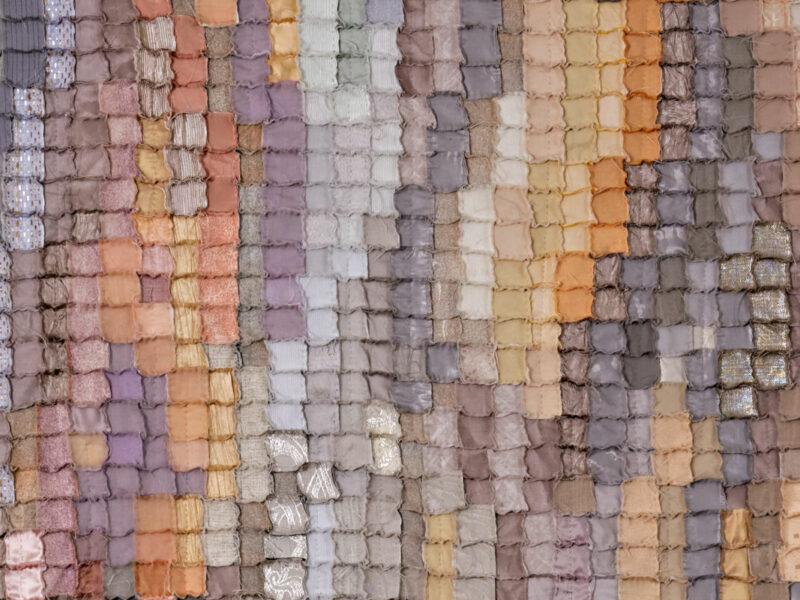
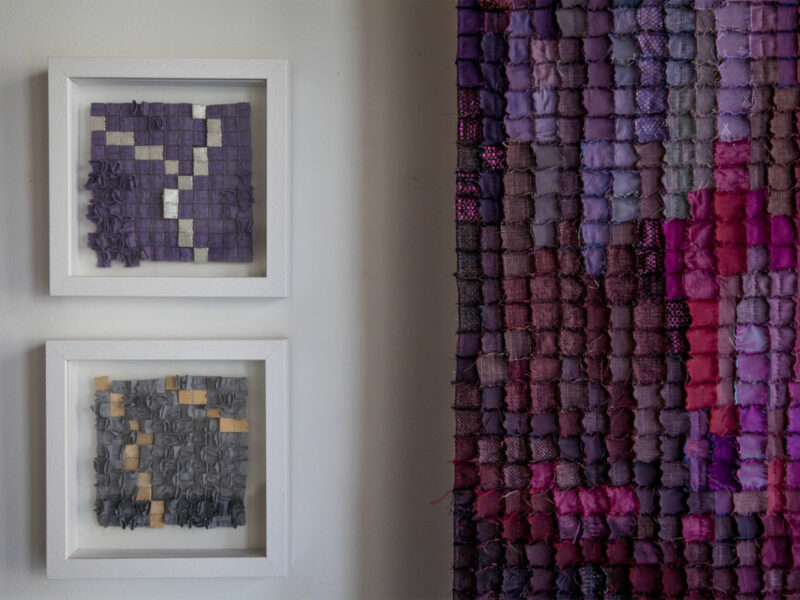
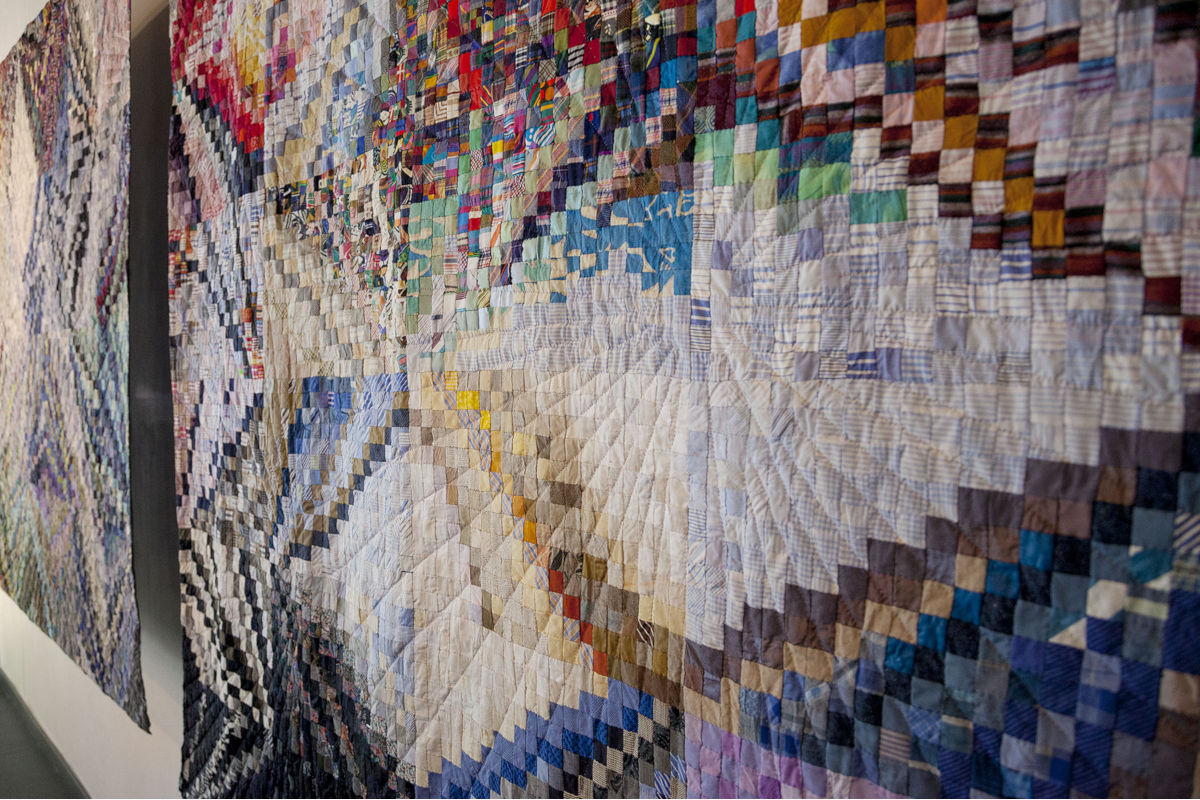
The construction and tonal landscape of each piece is supremely poetic — considered individually and as a group of compositions that fill the gallery — and unique, where each panel is a singular entity that invites the reflection of both light and thought. Her technique is inspired by different arts and crafts in a series of woven movements, dances, flows, tempos, and repetitions. Sabine Cibert adapts her work to the slow pace of each day, allowing for the interplay of light and shadow as bits of fabrics are gradually sewn together as her inspiration is formalized. But she can also shake things up by using computer software that accelerates her technique, allowing her to adapt, compose, and combine textures more rapidly. This may be why we feel the architectural effect of build up and break down at the same time, of humming and silence, of expansion and concentration. As it navigates the walls of the gallery, this amazingly disrupted continuum creates an intensely mobile space. The artist herself explains that each tapestry, whose design resembles the lines of nomad tents, was crafted as a dialogue with space on a larger-that-life scale.
The title of the first piece shown at Aqueduc, Espace-temps 4, reinforces the impression of movement. Everything works to emphasize mobility, from the width of the panels to their chromatic line, the multiplicity of squares, and the wrinkling of the cloth. We immediately notice that the artist’s work is based on working with light. Wherever the work is displayed – either in a modern building with spacious bright surroundings or in a historical room with high wood-paneled ceilings in Vieux-Lyon – each piece develops its own relationship with its surrounding space and strikes its own rhythm. There is also a timelessness to these pieces that flow, like the nearby Saone and Rhône, at the junction of contemporary and classic styles and at intersections of Sabine Cibert’s own complex geography that stretches from her urban roots in Lyon and long hikes in the Alps to her travels farther afield and the variegated sources of her materials.
Each tapestry is an event that contributes to defining the whole show. There is something cinematographic – why not? – about the process, like a film-within a-film that retraces the origin of movement, dressing up life and death the way wind embraces the contours of a body. Can we make out the form of an original abstracted figure here, embedded like the original layer of a palimpsest that the weft threads let rise to the surface and become visible? In spite of this density, lightness is very present, unsettling and rustling.
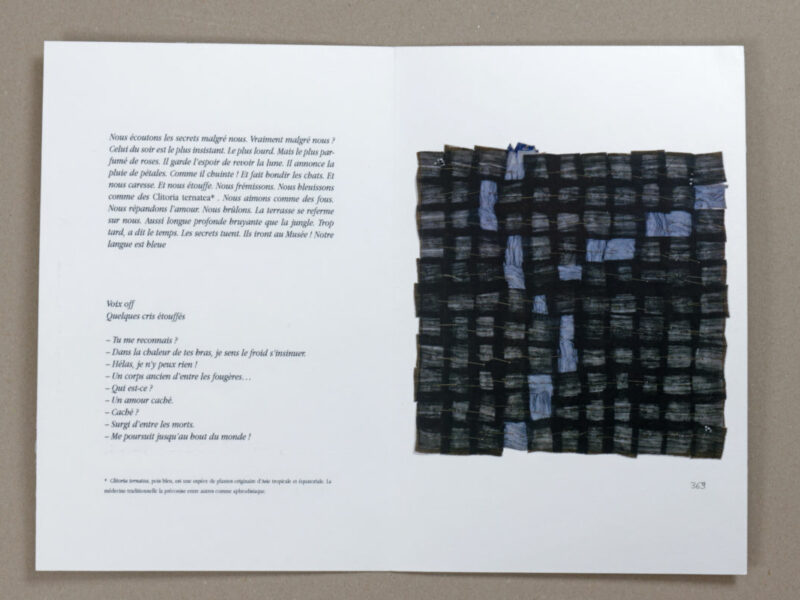
Especially in the series Espace-temps, I can feel the artist’s tireless desire to search for, experience and make the viewer feel the origin of forms and their pulsating rhythms. The tiny grey-black squares that meander over an orangey triptych remind me of bits of film. Each “frame” seems to suggest a watchful eye that also allows itself to be observed, inviting close attention to their blackness and recalling how René Char used to say that black contained ‘the impossibility of living.” As in most of her pieces the artist’s hues are extremely subtle, ranging from greys to blacks, from the lightest to the darkest shades, from the echo of a shadow to bright bursts of orange. Colors here convey a double feeling of the expansion of a warm kaleidoscopic field as well as a sense of miniaturization: when we examine a hanging closely, we see that each small dark square reveals a world within a world, interior and exterior scenes, with branches, winter gardens, figures, or a shadowy room. Collectively, they represent effects of translucence, shadow puppetry, and opacity.
Once again in the Espace-temps series, the fifth piece shown at the Showroom Galerie also emphasizes a movement that swells like a sail and enhances the journey of light in sequential loops of tiny black squares. The vibrant use of yellow is fascinating and underlines the subtle interplay of translucence and opacity. We find the same technique in another unusual piece entitled Reminiscences that seems to blend with its supporting wall, reinforcing the notion of a palimpsest. Besides the reference to Kandinsky, the notion of reminiscence projects one infinity, as the black and white checkerboard constantly rephrases the question of origin. These impressions are maintained by the “inside out working process, using an assemblage technique called kuna mola or reverse appliqué: a method of sculpting with fabric traditionally used by native American women inspired by the ornamental geometric designs painted onto their bare chests.
Like the other pieces in Espace-temps, Reminiscences suggests a marvelous definition of the creative act: first, to introduce a relationship with other worlds, languages, and techniques before turning away from the creation. Then, the artist’s task is to preserve the dual principle of harmony and phrasing in the finished piece, which may become an esthetic path to the sacred or at least to the sublime. But as Sabine Cibert insists, what is most important is to lock in and sustain on the element of astonishment and allow the public to rediscover, as the poet Charles Dobzynski explains, “the restless human desire that since Adam drives us to break open the strong-box of the unrevealed, to lift the mask of what is hidden, and to search for the unknown.”
From this perspective, it becomes impossible not to notice how Sabine Cibert’s work opens imaginary worlds to us. Franchir 2 is a typical example of this expansiveness. The idea of crossing over or “trangression”, together with the notion of serialization, of which the “2” is a reminder, both reminds us and complicates our relationship with the “object.” But what is the object telling us? Franchir suggests a delicately constructed bridge between figurative and abstract art. At first, the lines may evoke a woodland of tightly set boles through which we catch glimpses of sunlight; the lighter shades appear halfway up the tapestry and give a hint of a horizontal clearing. The shades of light blue that cuts through the middle of the piece suggest a clearing in the woods. But the trees are not simply woods but also represent the sum of all their parts — their inhabitants as well as objects that can be made from them: wind chimes, for instance, as well as birds of the forest with plain or exotic plumage, even the sky itself glimpsed between the trees and, more materialistically, the palette of blues that the artist has assembled. But the woods are also a locus of the fairytale. So the long colored lines cease to be simple tree trunks because they also weave a narrative as the vines of fabric twist and turn, creating a dreamlike landscape, splitting time into a pulsating rhythm of light and dark lines, into verticality and depth of field.
Similar convulsive movements appear in the panels entitled Instants 1 and 2, in a flowing motion between microcosm and macrocosm, confluence and difference. The viewer sails on a sea swell of diagonals and diamonds, caught in their sinusoidal waves that recall Saint-John Perse’s bold lines: “So the sea came towards us in its old age and its ample Hercynian folds.” In these two “tableaux,” we can clearly discern the artist’s architectural training. The repetition of losanges, the highlighting through use of small squares, the visible marks in the textile that represent objects or plants, all this gives the beholder the illusion of penetrating into the center of a town or rather the shape of a town, stunned, Julien Gracq, by the “canvas of streets, avenues, and parks,” swept up by “the dizziness of its transformation.” The crux of the artist’s work is probably found here, borrowing the suggestive title The Shape of a City from the writer. The mobile, ever-changing form, its infinitely malleable gestation and elaboration are all integral to Sabine Cibert’s artistic project.
It’s no wonder then that her formal language seems so poetic to us, and that it destabilizes conventional language and any rigid use of space. The world imagined by the artist is grounded in Transition, one of her most significant pieces. Even the empty space between the panels of this triptych contributes to the work: lines that seem to spring from one shore to the other, so to speak, and simulate, in shades ranging from blue to brown via beige, different states of matter — dry or wet, sandy or compact, its depth and surface.
Starting from the left panel, tiny waves begin at the far edge, moving from an unseen origin and elevating the invisible to the visible. By contrast, no line on the right panel touches the opposite edge. But something is going on, a ribbon of fabric, a stem, a vibration, whatever it may be! Like radio waves, these frequencies move anyone who is willing to accept the unexpected. These “listeners” see and hear this new “Ragtime,” a musical style and the eponymous title of a painting by Theo van Doesburg that has inspired Sabine Cibert. But she interprets it quite freely in her own style by collecting and assembling her own fantastic “bits’ of notation.
Chantal Danjou
Poet, novelist, essayist
January 2017
Translation Maïca Sanconie
Exposition Emergence Lyon Showroom Galerie 7 – 2016 – France
Exposition Dardilly L’Aqueduc – 2016 – France