Studio notes
except DECISION MAGAZINE JUNE 2022
Revue littéraire annuelle, une création des Éditions Orizons
25, rue des Écoles, 75005 Paris
Founding director: Daniel Cohen Editor: Chantal Danjou
orizonsediteur@orange.fr
migrale@orange.fr
Studio Notes
” Je porte en moi tous les paysages, j’ai tout l’espace voulu. “
“Alle Landschaften sind in mir vorhanden. Und es ist auch für alles Platz.”
Etty Hillesum 1941-1943
At a moment far removed from the design stages that grab my full attention, I wrote these notes, drawing from texts written by specialists about my work, especially for applicant files.
Even though I have chosen colour, textiles and huge formats to express what I want to share, I am now seeking the words to explain and translate the creative wave which gathers gradually in the depths of my intellectual and bodily memory.
I explore vibratory similarities between the sensing of landscape, inner turmoil and the metaphor of perceived several landscapes via a palette of colours, that unfurl across a geometric foundation designed to project material power. Inspired by the forces of nature, my compositions act as a transposition of telluric forces and a soundtrack to inner landscapes. As a medium belonging both to everyday life and universal experience, the textiles gently guide the onlooker towards abstraction.
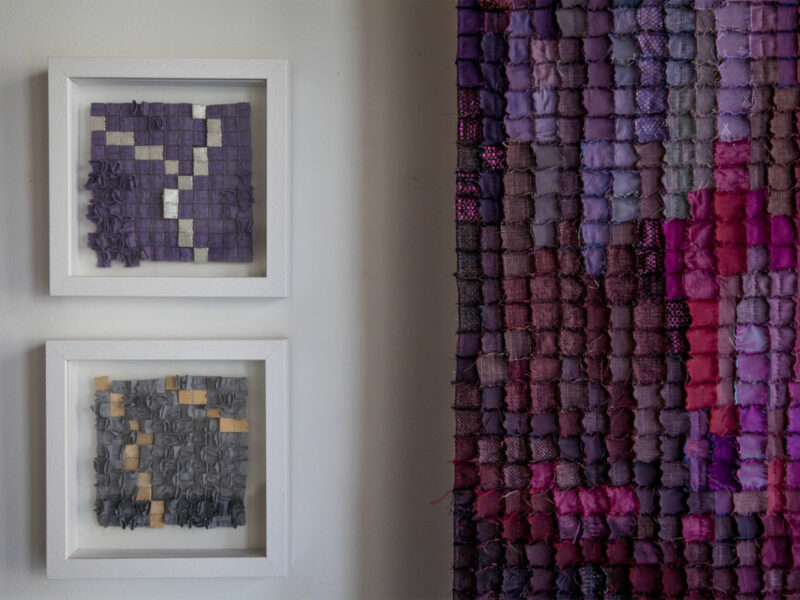
Breaking free from the benchmarks in traditional quilting, I have invented an entire personal vocabulary, arranging a huge variety of textiles that I have collected over several decades. Since 2017, I have been exploring a new surface effect, using relief in certain works, achieved by turning them over to the wrong side. This 3-D material, akin to fur, feather and scale, further procures an enveloping sensation, bordering on sculpture.
My creative approach is fuelled by two types of research, without there being any initial connection: firstly textile catalogues and colour ranges, and secondly, lines of force and graphic studies.
For decades, I have been collecting entire catalogues of textiles in the colour ranges I yearn to explore. My textile collection includes several musts including cambric, bazin and end-on-end weaves. But sometimes, without knowing why I will buy a nuance, in a random corner of France. Then, as if by magic, I find that it rounds off a collection three weeks later. Textiles also may be gifted to me unexpectedly – printed silks from the Fifties or a set of reds for example – and again, they round a collection off.
When putting together a range of colours, I seek out a great variety of what we call “noble fabrics” in French (cotton, linen, silk and wool) and also of weaves, a weave being the method of interweaving the yarn to make fabric: canvas, satin, herringbone and gabardine to name but a few.
At a given moment, geometry, lines of forces, and a textile collection all come together to trigger a textile composition which often grows into a series.
For instance, the lines of force in the Moments and Running Water Series started out from a snowscape photocollage, duplicated into 24 minuscule 2.8 x 5.5-cm rectangles.
As a student of László Moholy-Nagy at the Bauhaus, Karl Hermann Haupt conducted visual experimentations with photocollages in 1923-1924. He explored the effects of lines of force, the links between black and white, positive and negative.
In 1923, Bauhaus teacher László Moholy-Nagy, “the tireless apostle rooting for change”, had snuck photography into his foundation course.
He considered that it was precisely the “technical view”, the camera’s dispassionate observation, the mechanics of image production beyond the artists’ individual creative urge which made photography the right medium to create a pictorial language to describe the modern world, thanks to which human perception would be enhanced with the addition of a new visual dimension. Moholy was not at all seeking to achieve direct reproduction of what existed, reality, but the conception of a new world underpinned by the spirit of technique:
“The secret of its effect is that the camera reproduces a purely optical image, thus showing deformation, distortion, shortcuts, etc. which are optically true, while our eyes and intelligence compensate for the optical phenomena captured, formally and spatially, to transform them into a pictural representation.”
(in Bauhaus p 512-515 Jeannine Fielder Peter Feierabend 1999 Édition française)
After ten to fifteen years of maturation for this photographic montage and many hypotheses on transposition, I was able to find his interpretation, especially the relevant scale.
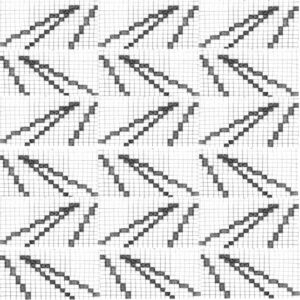
Sabine-Cibert-Source-Instants-Facsimile-Karl Herman-Haupt
Facsimile of lines of force in Karl Hermann Haupt’s photo montage 22 x 8.4 cm
In the Moments and Running Water series, I have retained the principle of repeating the motif and its mirror.
With a larger format, I place emphasis on the visual effect of light diffraction and vibration.
The rigid lines help to create a dynamic atmosphere where everything is in motion.
The block points in four directions for the works in Moments and two for those in Running Water.
Fac similé des lignes de force du montage photographique de Karl Hermann Haupt 22 x 8,4 cm
Extracts from the Moments series 2011- 2016
textiles assemblés main, quilting main sur support toile à travers une âme en soie.Hand-assembled textiles, hand-quilting on a canvas base with a silk core.
The block’s change in direction, the very broad colour palette and the great variety of weaves all work to create an illusion of pixellisation, like an echo that propagates then bounces back in all directions.
Between microcosm and macrocosm, convergence and divergence, onlookers navigate through swelling diagonal lines and diamond shapes, trapped within sine curves.
These two “tableaux” each point to my background as an architect. The repeating diamond pattern, the tiny squares marking the work, a glimpse of objects and plants in the fabric prints all give visitors strolling past the illusion of getting to the heart of a city, or rather its form, in the grip of “giddying metamorphosis”.
Extract, Running Water series 2015 – 2019
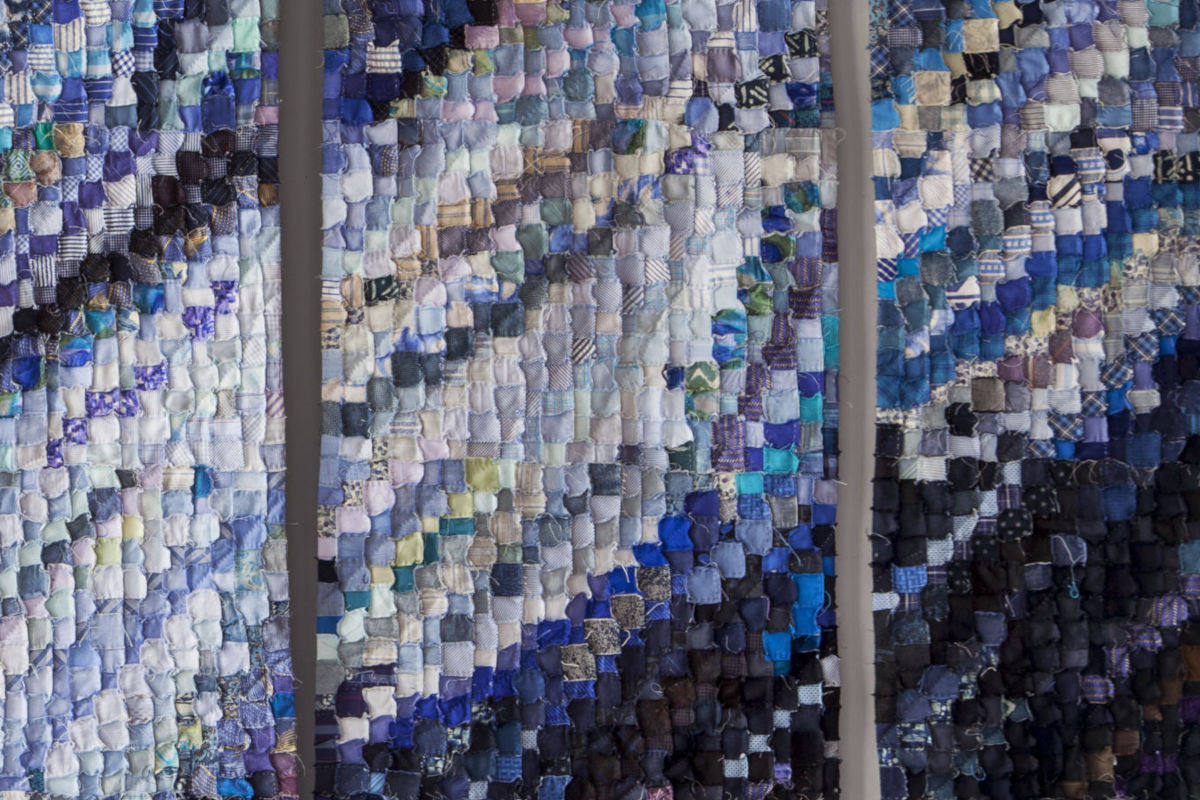
Eau vive 1 | 152 x 144 cm | n° 186.2016.3 | 4095 fragments de 3 x 3 cm
textiles assemblés main assemblage en trois dimensions ou assemblage classique quilting main sur support toile à travers une âme en soie
Running Water 1|152 x 144 cm
No. 186.2016.3
4,095 fragments, 3 x 3 cm
Hand-assembled textiles in three dimensions or classic assembly, hand-quilted on a canvas base with a silk core
From Annecy lake where I grew up, to glacier melt on Mont Blanc which I contemplate from my Alpine studio, I use large textile compositions to evoke atmospheric phenomena, sudden changes in light and the telluric forces of nature.
Running Water 1 and 3 are inner landscapes inspired by the violence of Nature.
From uterine immersion to tsunamis, torrential rising rivers to crossings on makeshift rafts, from Hokusai’s waterfalls to Monet’s Water Lilies, water is vital and untamed, protective and destructive, nourishing and annihilating. To tame it and shift our point of view, humankind has to contend with its sheer strength.
Trapped in these movements, the onlooker is confronted with a change in scale in both time and space of swift, misty, lightweight water, monumental in proportion and set in ice.
Here, the Karl Hermann Haupt motif produces has been harmonised in myriad shades of blue, softened with an oblique line. The vibrant composition appears to flow, or spring, from left to right and vice versa.
Snapshots taken of the underside of Running Water 1, just before concealing it between the three layers, fuelled the creation of another material effect, in a larger format, for Running Water 3.
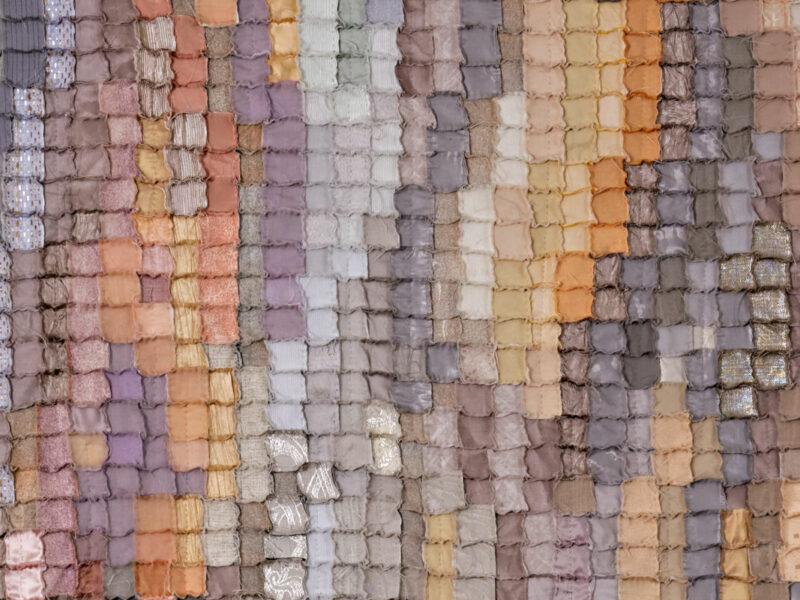
This brought into being a 3-D surface, a whole new material. Each of the 6,825 tiny textile squares seem to melt into their neighbours, creating a blurry optical sensation, bordering on Impressionism. The textile squares have gained mobility, looking swifter, tumbling down a sharper slope in a landscape at the confluence of light and shade. This new assembly featuring relief achieves a floaty, sensual effect, as if fabric were layered with ether.
“The same topography exists between the inner movement of the human body and that of the world.””
Fabienne Verdier
Text by Sabine Cibert, borrowing from the writings of Chantal Danjou and Thomas Leveugle, in addition to the quotations.