

Missing tapestries from the Massif Central – FITE 2022
Excerpt from the FITE publication Festival International des Textiles Extra ordinaires 2022 Imagine !
HS_Projets,
ville de Clermont-Ferrand,
Musée Bargoin,
Clermont Auvergne Métropole
Exhibition Clermont-Ferrand 2022 – France
In 1882, the cycle of La dame à la licorne (The lady with the Unicorn) was taken from the Creuse region of France and the castle of Boussac¹ to be placed in Cluny Museum in Paris for 25,000 gold francs. Thirty-five earlier, famous writer George Sand and Prosper Merimée, her lover at the time, has looked at these picturesque relics of the Middle Ages “long abandoned to the rats” in the castle that had become that had become a sib-prefecture. Sand’s wish was then that “the administration of fine arts would make copies painted with accuracy to enrich [the] national collections, so necessary to the modern works of artists”, specifying that she was not “in favor of the somewhat arbitrary monopolization, in the capitals, of the art riches scattered on the soil of the provinces.”
A fruitless wish for a woman who liked “to see these monuments in their place, as a necessary crown to the historical aspect of countries and cities.”
The fate of the Dame à la licorne should note make us forget that the Massif central still has a rich heritage over its territory. In the abbey of La Chaise-Dieu, there is a complete cycle retracing the life of Christ and Virgin Mary dating from the early 16 th century, which has remained in the building since 1518. In the Chateau de la Tremolière in Anglars-de-Salers, ten so-called aristoloches tapestries, woven in a workshop of La Marche¹, decorate the walls.
Since 2020, Sabine Cibert proposes, just like Georges Sand, to take a curious look at the neglected heritage. First within the support of the school of Pedagogical Innovation of Saint-Bonnet-de-Salers. Created in 2018 following the closure of the village school, the School of Pedagogical Innovation allows 100 classes from the Pays de Salers and the Cantal department to participate in cultural ans scientific discovery projects.
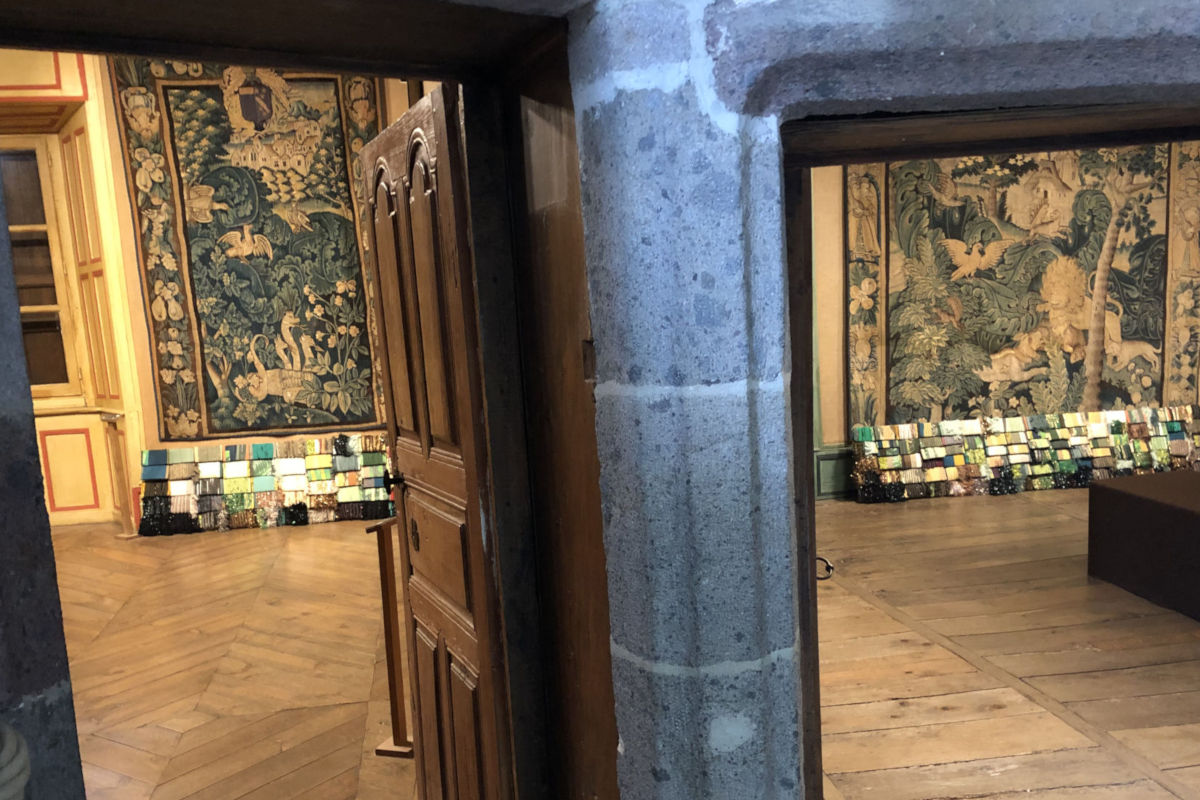
With the support of the media library otf the Pays de Mauriac area, which exhibited a selection of Sabine Cibert’s works for a month, 5 classes of 11 to 18 pupils could discover the cycle kept at the Chateau de la Trémolière, and learn to identify the more or less fantastic animals the castle is adorned with. Then, in the presence of the artit, the children analysed the colored variations of the tapestries. Following the example of the romantic author, they were able to perceive “the fold, the matte and the lustrous aspect of fabrics, […] the brightness of gems clips, and even the transparency of the gauze”.
They also realized that the bottom border of the tapestries was missing. This, the starting point of the project toouk shape: it was necessary to create the missing part.
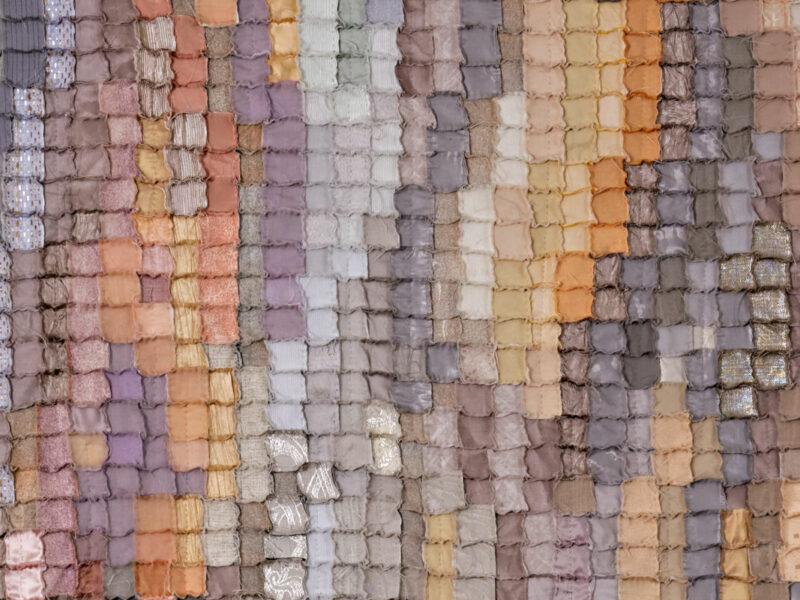
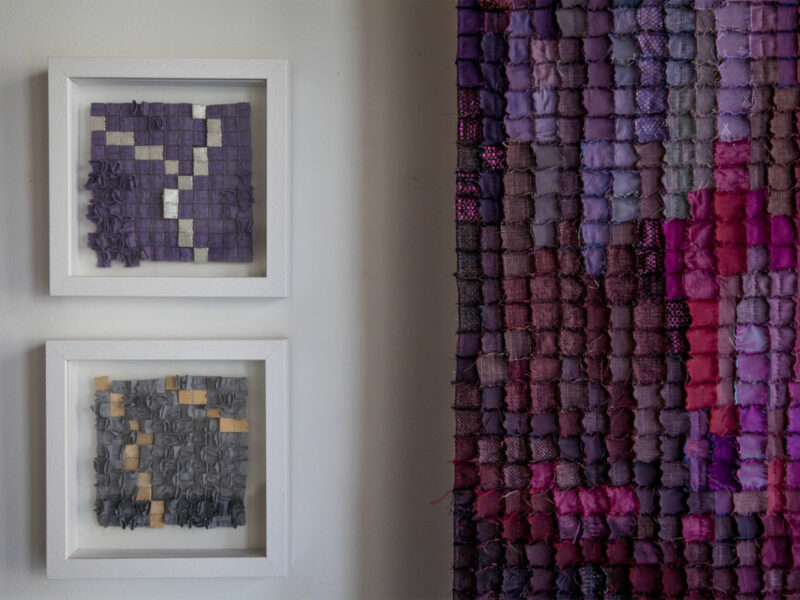
Using a process already used in 2020 during Regards textiles sur les tapisseries de la Chaise-Dieu, thin plates were covered by the winding of a rich set of selvedges with a colorimetry adapted to the tapestries.
Assembled one to another with changing details due to the different ways, visions and hands of the children, these textile ans colored plates arranged under tapestries make the link between the Middle Ages and our time.
At the same time, in Haute-Loire, in La Chaise-Dieu, the same formats of plates has been assembled in prisms of triangular section then grouped into two textile sentinels. Another missing part, just as poetic, is taking shape: two pillars of the abbey’s cloister which had been destroyed during the French Revolution is rising again. Just as in 2020, this project is intergenerational, since it involves the residents of a Medical and Educational Institute, the people form one Recreation Center and from two EHPAD (retirement homes).
With Regards Textiles sur les tapisseries de la Chaise-Dieu and La part manquante, the FITE offers the inhabitants of the Massif Central an amusing and contemporary look at the region’s textile heritage. Thus George Sand no longer needs to wonder “if some native has taken the trouble to discover what these remarkable works of art, tarnished by the centuries, represent or mean.”²
Thomas Leveugle
HS_Projets projects manager, FITE general curator
Festival International des Textiles Extra ordinaires
traduction FITE 2022
¹ Petit village de la Nièvre
² SAND George, Promenade dans le Berry. Mœurs, coutumes, légendes. Préface de Georges Lubin, Complexe, s.l., 1992, coll. Le Regard Littéraire, n°55, pp.94-101