Partitions textiles
Preview speech
les partitions textiles de Sabine Cibert at the Manufacture
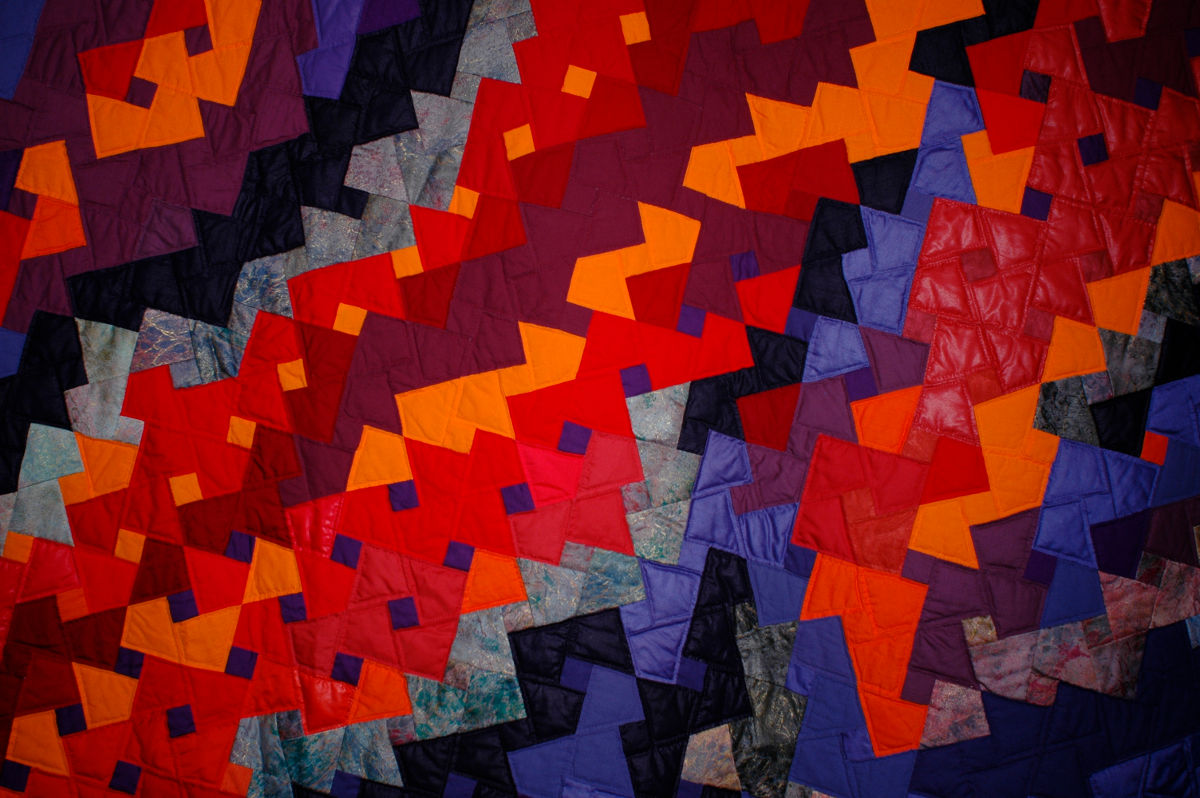
The “partitions textiles”, the word “partition” is rich. It comes from latin “partire”: share, separate.First, share: share the 3 influences which support Sabine Cibert’s artistic style.Ancient quilts, traditional popular textile art, made by poor or exiled people who tried to compose their fabrics with bits of second hand material.
They assembled those pieces with taste and desire to make a work of beauty playing with the colors, shapes and the range of textures, as may be seen in “Log cabin light show” (2005).This essential work is inspired by a 1860 Dutch quilt, where the various square pieces draw other square patterns created by optical illusions.
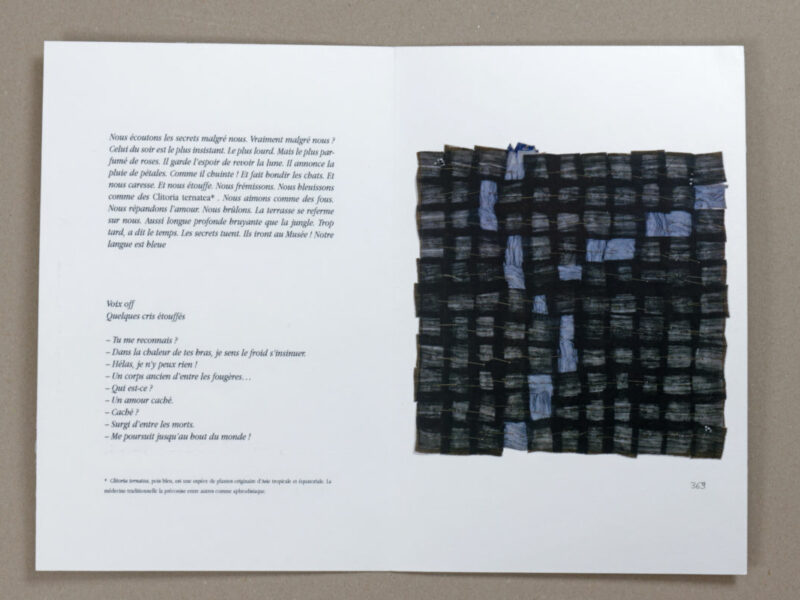
The Op’art explored by Victor Vasarely is thus already appearing at the end of the 19th century through those skillfull creations.Second, the Bauhaus artists whose works have fascinated Sabine Cibert and whose spirit can be seen in several “partitions. “Reminiscences” (2012) is imbedded in Vass-ily Kandinsky’s black and white square, abstract, enigmatic shapes.
In “Une ville la nuit” (2012) can be found a Paul Klee’s harmony of colors and shapes.In “X²” (2009) Sabine Cibert explores the light as in the stained-glass window tech-nique, inspired by a work of glass bricks imagined by Josef Albers.Another work “Kan Geiko” (2002) can be added to the list.
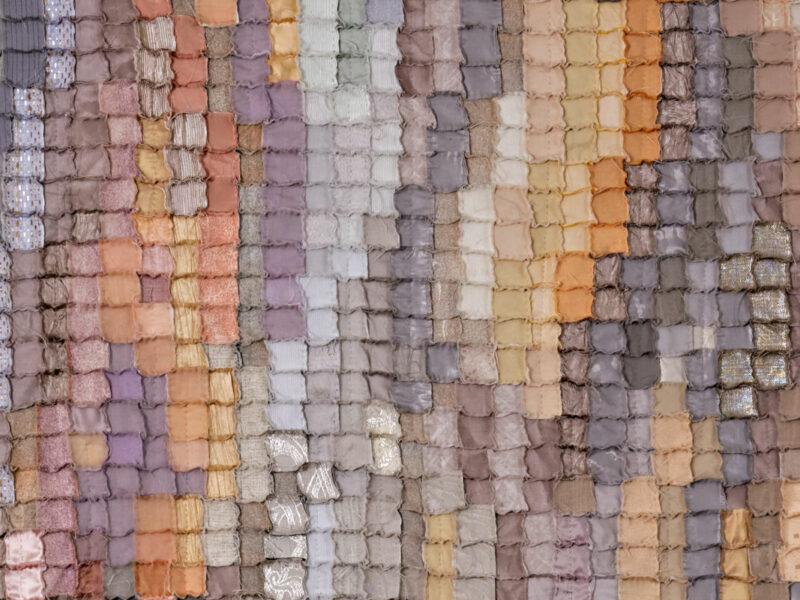
The design represents blocks of assembled triangles dear to Gustav Klimt who does not belong to the Bauhaus but is contemporary.Third: The mosaics of the Alhambra in Granada. This influence is found in “Abyss” (2004) and “Confettis sur Rio” (2003); in the last one the sky full of confetti contrasts with the Harlequin patterns loved by Vasarely.The idea of musical sheet is meaningful here with the harmony of colored rhythms composed according to the material types, their texture, feeling and shine.
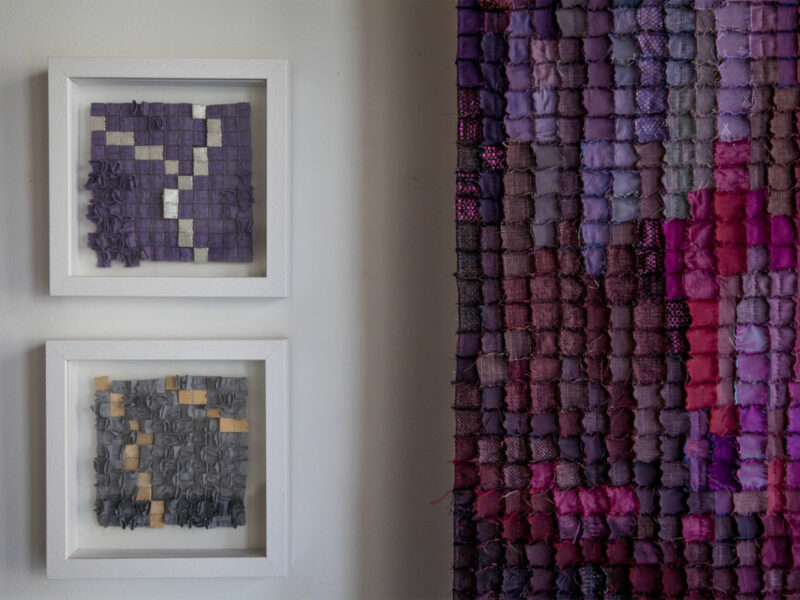
All the magnificent nuances can be seen on the large formats in the exhibition.The art of creating a construction and motifs interlink with subtle variations and opti-cal illusions is made by the exact sharing out of the geometrical shapes of the textile pieces.
Another solid belief of Sabine Cibert is sharing and meeting with people after her tex-tile creations. Textile is the first social material we come in contact with from our birth and which envelops us. Connected to her architect experience she enlivens the walls in our life spaces with her textile works; thus she creates a lively atmosphere with a human dimension.
Let us thank Sabine Cibert for her large “partitions textiles” with warm and iridescent colors, the result of a thorough patience.We hope that our students and the visitors will be dazzled and will share our delight.
Marc Le Person
Professor of the Universities
Chargé de mission at the Cultural Affairs of the Jean Moulin University Lyon
February 2013