

The song of dawn
The song of dawn
Text from pages 119–120 of the publication 2026 Beauté(s) Biennale Textile
HS_Projets
Ville de Clermont-Ferrand
Clermont Auvergne Métropole
Silvana Editoriale
Exposition Aubusson 2026 – France
The Cité internationale de la tapisserie d’Aubusson is hosting Aube 281 by Sabine Cibert, situated not far from Jean Lurçat’s Chant du Monde, woven in the Tabard workshop between 1954 and 1966 and exceptionally on loan from the Musée d’Angers. This juxtaposition also bears witness to the history of the twentieth century.
From 1957 onwards, Jean Lurçat set out to create
a monumental, testamentary work: Le Chant du Monde (Song of the World). At the origins of this cycle lies the artist’s discovery of the Apocalypse d’Angers on the eve of the Second World War, in July 1938, as well as an initial version woven in 1947 for Notre-Dame d’Assy in Haute- Savoie – an illustration of the Apocalypse of Saint John. But its true origins lie in Jean Lurçat’s encounter with Rainer Maria Rilke in 1912.
Le Chant du Monde echoes the Duino Elegies, in which Rilke conceives of the state of beauty not as a grace but as a passage beyond which everything is
at stake: “For Beauty’s nothing but the beginning of Terror, we’re still just able to bear, and why we adore it so is because it serenely disdains to destroy us1.” As with Burke, beauty is close to the Sublime, that “delight mingled with a touch of terror2”.
Jean Lurçat distils the poet’s spirit, where the monumental beauty of the woven work rubs shoulders with the anguish of the contemporary world, oscillating between atomic threat and hope: “The world will dare to approach the Song only when the great Threat of that immense, foul pustule of the Bomb has, by common consent, been torn from the flesh of mankind. I contribute my part3.”
Lurçat sought to create a work of remembrance, drawing on the technique and format of historical tapestry. With its ten pieces, the monumental cycle remains the largest contemporary tapestry ensemble to this day. The uniform black background is like a boundless, lightless universe. Floating in this void are the ghostly images of a foretold apocalypse, that of the end of humanity and its possible resurrection.
Although the cycle was incomplete – it would be completed in 1966 after Lurçat’s death – it was presented to the public for the first time in 1963 at the Musée Château d’Annecy by its young director, Jean-Pierre Laurent4. The exhibition featured a sound installation. A year earlier, on the other side of the border, Jean Lurçat and the couple Alice and Pierre Pauli founded the Centre International de la Tapisserie Ancienne et Moderne (CITAM)5 and inaugurated the first International Tapestry Biennal in Lausanne. This event established textile art within the field of contemporary art, paving the way for fibre art.
In Annecy, a young seven-year-old visitor, Sabine Cibert, a pupil at the city’s École des Beaux-Arts, discovered Lurçat’s Le Chant. Sixty years later, that first encounter still stays with her.
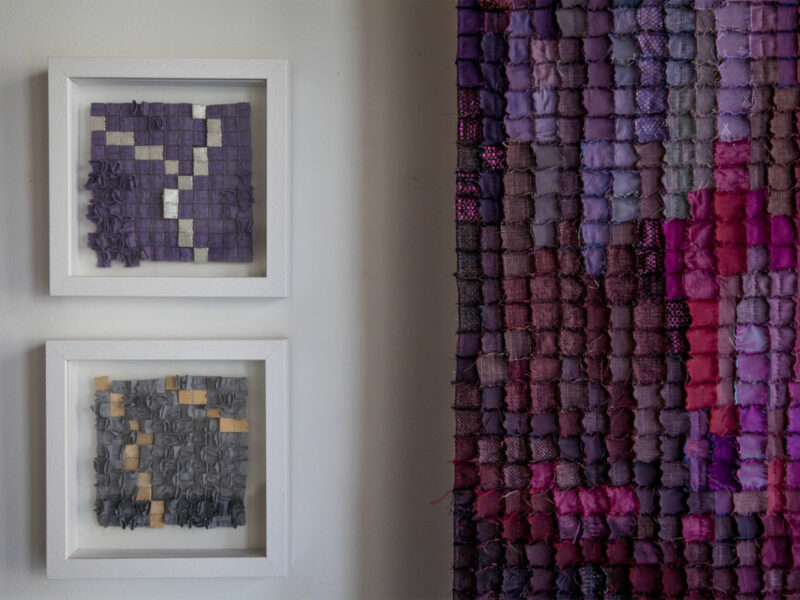
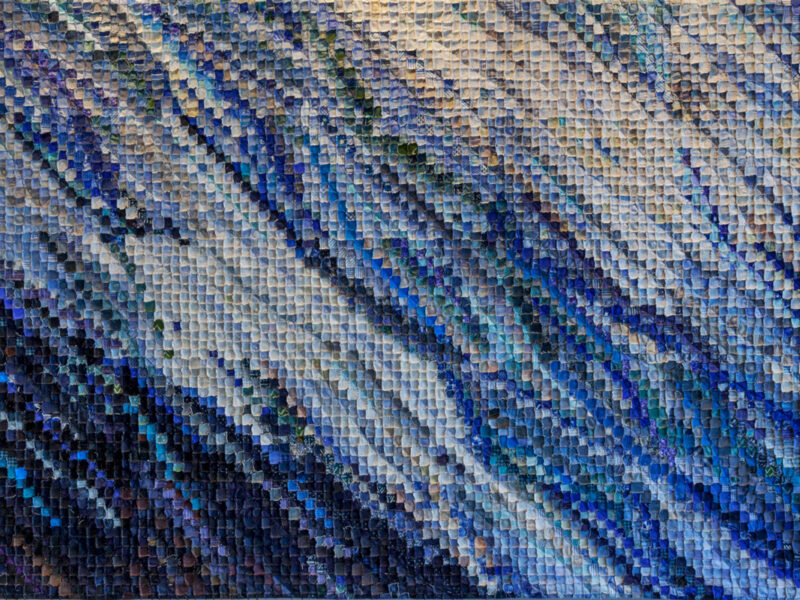
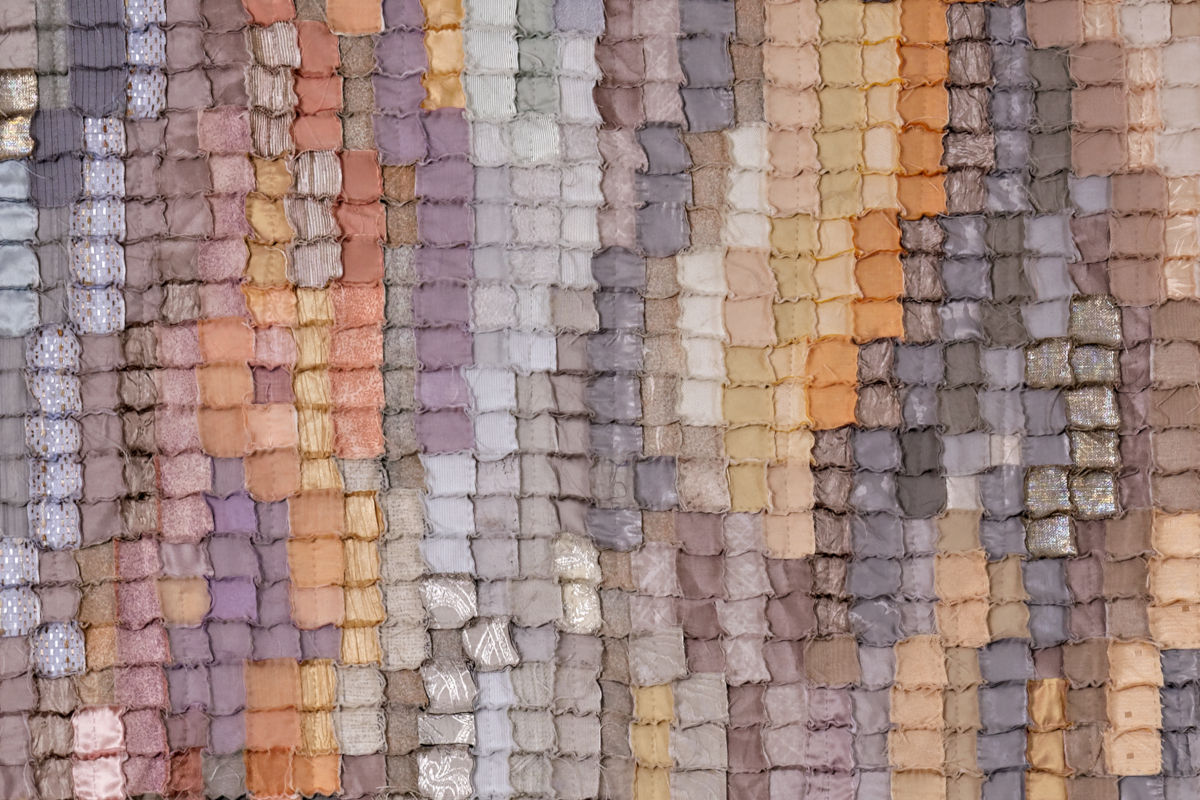
Aube 281 offers a sequel to Le Chant du Monde and the Apocalypse d’Angers. Like the weaver who creates a pattern from dyed wool, through long and patient manual labour, Sabine Cibert uses existing textiles, treating them with the rigour and sensitivity of a colourist (fig. 5). The vertical format is that of Homme d’Hiroshima and La Fin de tout. But here the shattered rose, floating in the immensity of the star-studded universe, gives way to the birth of the colour of day. The appearance of Dawn. Lurçat’s black backgrounds fade away; only the atmospheric sensation of coloured light remains. Another day is possible.
Thomas Leveugle
Curator of the Textile Biennial – Clermont-Ferrand
4 Jean Lurçat, Les Tapisseries du « Chant du Monde », Annecy, Gardet, 1963.
5 Giselle Eberhard Cotton et Magali Junet (dir.), De la tapisserie au Fiber Art. Les Biennales de Lausanne 1962-1995, Milan, Skira, Lausanne, Fondation Toms Pauli, 2017.
translation Contextus, Pavia: Lucian Comoy, Sandrine Merle