The Skin of the World
A glance at Sabine Cibert’s textile artwork
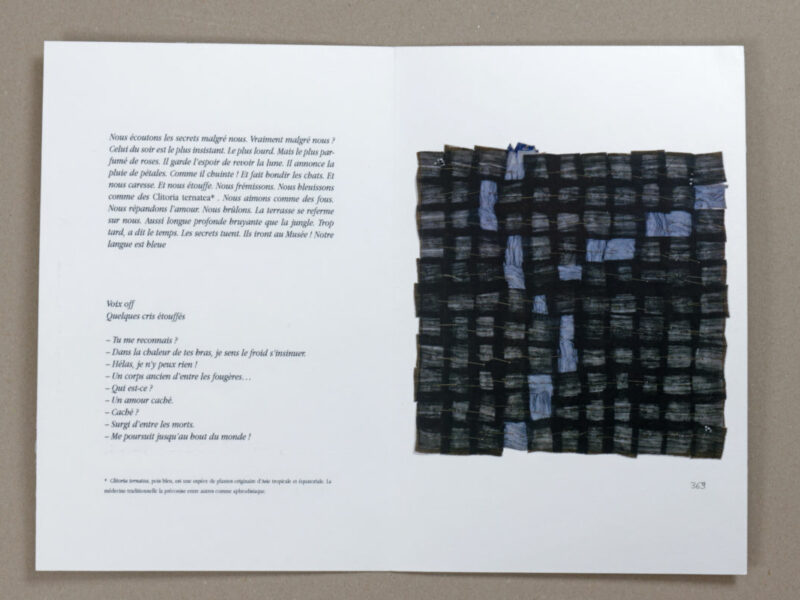
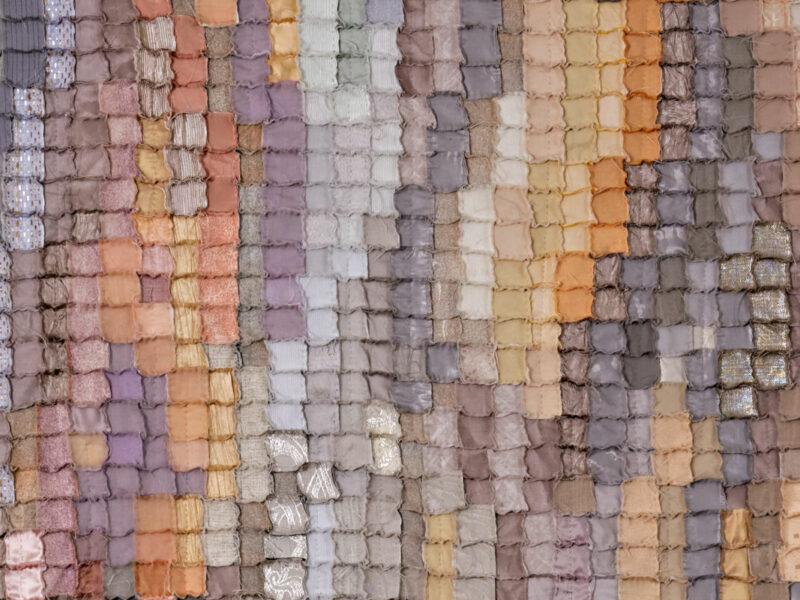
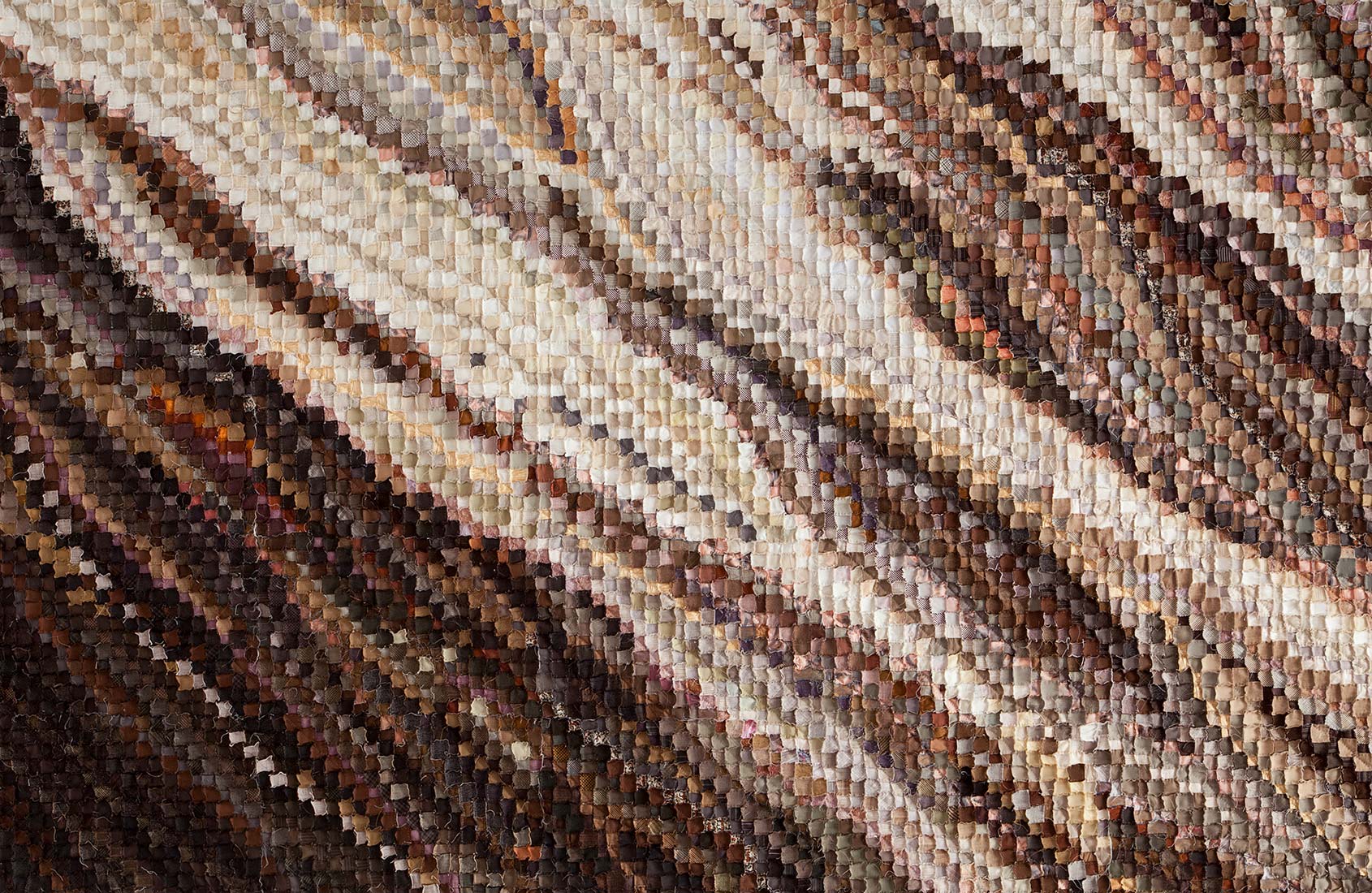
At first sight, the piece is puzzling. What is it? Where does it come from? From which period?
How strange thus to add up colours and materials…
The aim of Sabine Cibert’s work, now settled in time, remains mysterious.
At first sight.
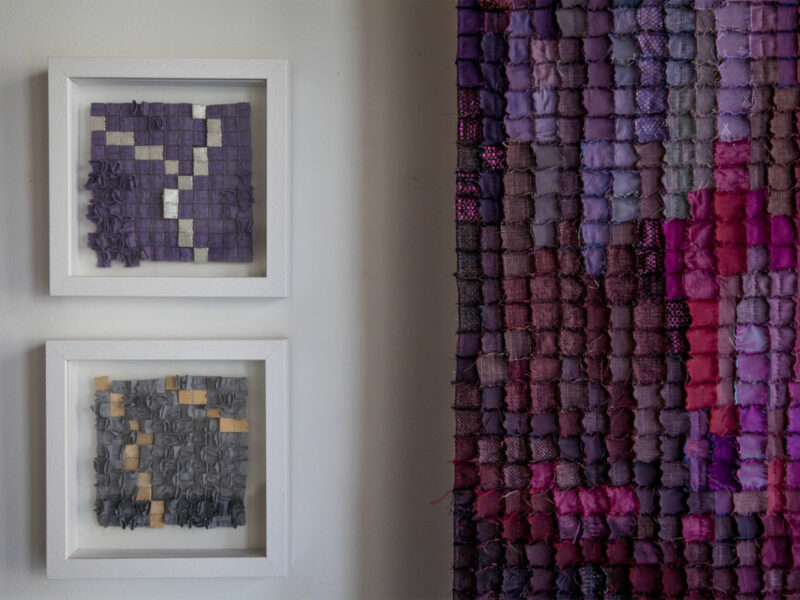
There it is, exhibited amidst contemporary art and naturally set up in various places, sometimes unusual. Nothing frightens Sabine. She is eager to show her work.
There is some evidence in her work.
We think we know it, we’ve already seen it …
Logotypes, forms, colours, their timeless attraction are very reassuring.
The radicalism of the vertical surfaces and of the strong visual effect of her works, are impressive and expressed through a soft powerful presence.
You think you’ve already seen it? Yes, on an Inca temple or on some modern and industrial architecture, on the line of a leaf or deep in the heart of a mineral crystal.
It means there is something universal in Sabine Cibert’s work.
The slow metamorphosis of the representation codes is her field. She knows quite well the elements that have been building our visual consciences and our ways of viewing art for ages.
Abstract, realist, figurative art … It doesn’t matter to her!
Far from the established categories, Sabine Cibert rather likes considering the basic links between human beings and noble materials, those which protect from the cold, those which give pomp to civilizations and bring plenty through trade. Indeed the birth of mankind trading goods and protected from the cold, merges with the textile story. And thus meets with the necessary birth of languages and their crossbreeds.
What Sabine is deeply interested in is the “skin of the world” embodied in the living and malleable material. Apparently fragile, but sharing a part of eternity, the dazzling speed of the textile worlds refers to another rich crossbreed: agriculture which produces the original fibre and the colours made from vegetal or mineral pigments.
Could there be a more beautiful skin for the world than the material synthesizing the elements of a mastered nature?
The palette is ready. The palette of human beings who have understood from the beginning, that what I wear is nothing else than what I am in a world of signs and looks.
Indeed if my name and my tribe are not written on my skin, I can wear a garment that identifies me. Then I can feel secure, protected and visible. The body enveloped in its textile ornament is no more anonymous. The textile civilization which submerges all about mode and looks, obviously over represents everyone’s identity.
In their strong urge to civilization, human beings then give substance and life to their homes. Remaining nomads or becoming sedentary, the same quest for identity still drives them.
What remains of me is what one is able to see, what I let see.
The logotypes refinement expresses the subtlety of any language codified by civilization and its seaside work, constantly eroding and embellishing each portion of its field.
The code has then become mysterious, lost in the night of humanity, though it makes everything up;
It is so beautiful and shines so brightly!
It is so inspiring for the soul of the person who, without knowing, meets again an old acquaintance, a universal and solid paradigm!
Sabine Cibert’s work is the wave roller which, from time immemorial, on the world’s shores has been creating and re-creating the environment and has been monopolizing the nature material.
The work is carnal, full of moderation, as the materials refinement and the powerful line impose a slow rhythm, a waltz full of gravity, as time takes its time, the eternity one.
So please let us not spoil it with haste.
Sabine Cibert’s work takes its time of the waltz; it gives their rhythm to the waves, its sizes things up.
It is the sign of an art rooted in the deep movements of the world which offers its ancient evidence dressed with our colours and our human time.
Jean Sébastien Bach often wrote partitas, meaning little parts, in order to search his mind’s convolutions. This type of powerful expression links together two short pieces; one piece owes a lot to the previous one and gives all to the following one; but they can be appreciated separately as well.
This is the way Sabine Cibert’s work is shaped. It can be read in its evolution or tasted as a piece.
It is though essential to understand that her work is strongly related, down to the heart of the finest fibre of her work, to the unity that she wants to express.
Stéphane Salord
co-founder and co-leader of ESDAC
Ecole Supérieure de Design d’Art et de Communication d’Aix-en-Provence
June 2014